Neuromarketing advertising helps us understand why some advertisements stay in our minds while others disappear almost immediately.
You probably remember an advertisement from years ago. Maybe it was funny. Maybe the music was unforgettable. Maybe the advertisement made you emotional. Or perhaps you remember a particular character, colour, tagline, or scene, but you cannot remember exactly when you saw it.
Now think about the last 10 advertisements you saw on Instagram or YouTube.
How many can you actually remember?
Probably not many.
Every day, consumers are exposed to an enormous amount of advertising. Brands compete for attention across social media, websites, television, search engines, billboards and mobile apps. Yet getting someone to see an advertisement does not necessarily mean they will remember it.
This raises an important question for marketers:
**Why do some advertisements stay in our minds while others disappear almost immediately?**
The answer is not simply about having a beautiful design or spending more money on advertising. Attention, emotion, relevance, repetition and the way a brand is connected to the advertisement all influence what people remember.
1. How Neuromarketing Advertising Captures Attention
Before people can remember an advertisement, they generally need to notice and process it.
This sounds obvious, but it is one of the biggest challenges in modern advertising.
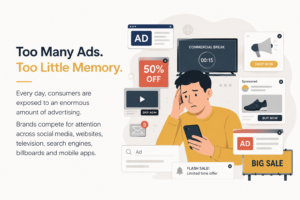
Think about scrolling through Instagram. You might see dozens of posts within a few minutes. Most of them receive only a fraction of your attention before you move to the next one.
An advertisement that looks exactly like everything around it can easily disappear into the feed.
This is why the opening visual, headline, movement, contrast or unexpected idea can be important.
Neuromarketing advertising uses these attention cues to help marketers understand what makes an advertisement stand out.
Research using eye-tracking has found a relationship between visual attention and advertising recall, particularly among people who are not already heavy users of the advertised brand.
But there is an important lesson here:
**Attention is the beginning, not the destination.**
An advertisement can get attention and still fail to create a strong memory. Neuromarketing advertising looks at this relationship between attention and memory to understand why some advertisements are processed and remembered more effectively than others.
2. Emotion in Neuromarketing Advertising
Think about the advertisements you remember most.
Many of them probably made you feel something.
You laughed.
You felt nostalgic.
You became curious.
You felt inspired.
You were surprised.
Or perhaps the advertisement reminded you of someone or something from your own life.
Emotion can make an advertising experience more memorable because it gives the information something beyond the product itself to attach to.
This is one of the reasons neuromarketing advertising often focuses on the emotional response created by an advertisement, rather than looking only at whether someone clicked an ad.
This doesn’t mean every advertisement needs to make people cry or laugh.
The emotion simply needs to serve the message.
A food brand might use comfort.
A travel company might use excitement.
A children’s brand might use playfulness.
A luxury brand might use aspiration.
The emotion becomes part of the memory of the advertisement. Effective neuromarketing advertising connects this emotional response with a clear and recognisable brand message.
3. Why People Remember the Ad but Forget the Brand
This is one of the biggest problems in creative advertising.
Imagine someone sees a brilliant advertisement.
They remember the joke.
They remember the actor.
They remember the song.
They remember the visual.
But when you ask:
**“Which brand was that for?”**
They have no idea.
That’s not necessarily a successful advertisement.
A memorable creative idea needs to be connected to the brand strongly enough for the audience to remember who was behind the message.
This is where **neuromarketing advertising** becomes especially useful for creative strategy. An advertisement should not only attract attention. Its visual identity, message and emotional experience should also help the audience connect the memory to the brand.
This is why logos, packaging, brand colours, distinctive characters, taglines and other recognisable brand assets should not simply be added as an afterthought.
The brand needs to belong to the story.
Neuromarketing advertising also considers how consistently these brand cues are presented.
4. How Repetition Builds Advertising Memory
You’ve probably heard marketers say:
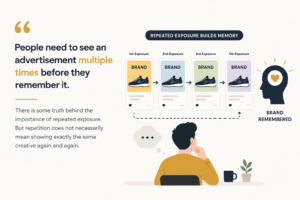
**“People need to see an advertisement multiple times before they remember it.”**
There is some truth behind the importance of repeated exposure. But repetition does not necessarily mean showing exactly the same creative again and again.
Research has found that varying advertising executions can contribute to brand-name memory.
Think about a campaign with the same brand identity but different executions.
The first advertisement might introduce the problem.
The second might show the product solving it.
The third might use humour.
The fourth might feature a customer experience.
The brand stays recognisable, but the creative experience changes.
This can give consumers multiple ways to encounter and remember the same brand.
In neuromarketing advertising, repeated exposure can be used to strengthen familiarity while keeping the creative content fresh and engaging. There is another problem with excessive repetition too: advertising can eventually become familiar to the point that people stop paying meaningful attention.
So the goal isn’t simply:
**Repeat everything.**
It is:
**Repeat the brand idea while keeping the creative experience fresh.**
5. Why Simple Ads Are Easier to Remember
A common mistake in advertising is trying to say everything at once.
A poster contains:
- Five offers
- Seven product benefits
- Three phone numbers
- Multiple fonts
- Several colours
- A huge logo
- Lots of tiny text
The marketer sees all the information.
The consumer sees a wall.
Good advertising often starts with a simple question:
**What is the one thing I want people to remember?**
If the answer is “our 20% discount,” build the advertisement around that.
If the answer is “we deliver in 30 minutes,” make that unmistakable.
If the answer is “this is a premium product,” every visual element should support that perception.
More information does not automatically create more memory.
Sometimes, removing information makes the important information easier to remember.
In neuromarketing advertising, simplicity can help reduce distractions and make the main advertising message easier to process.
This is an important principle in **neuromarketing advertising** because consumers have limited attention. A clear message can make it easier for people to process and retain the information that matters most.
6. How Storytelling Makes Advertising Memorable
People don’t always remember advertisements because they contain information.
They remember them because something happened.
A person had a problem.
Something unexpected happened.
A product changed the situation.
There was a funny ending.
There was an emotional moment.
Storytelling can turn a product message into an experience.
Research on advertising memory has shown that the way information is encoded and the cues available when people later try to retrieve that memory can affect recall.
For marketers, the practical takeaway is simple:
Don’t only ask:
**“What should we say about the product?”**
Ask:
**“What should happen in this advertisement?”**
That small shift can completely change the creative direction.
Instead of presenting five product features, you might show one relatable problem and demonstrate how the product solves it.
Instead of listing every benefit, you might build a short story around the customer experience.
The product becomes part of something the audience can understand and remember. This makes storytelling an important part of neuromarketing advertising, especially when brands want consumers to associate a product with a memorable experience.
7. Why Relevant Advertising Gets More Attention

Imagine seeing an advertisement for something you have absolutely no interest in.
You probably won’t spend much mental energy on it.
Now imagine seeing an advertisement for something you’ve been searching for all week.
Your reaction is completely different.
Relevance can influence attention and processing.
This is one reason targeted advertising can be more effective than simply showing the same message to everyone.
A good advertisement doesn’t only ask:
“What do we want to tell people?”
It also asks:
**“What does this person care about right now?”**
The closer the message is to the audience’s current needs, problems or interests, the more meaningful the advertisement can become.
Neuromarketing advertising helps marketers connect advertising messages with the needs and interests of their target audience.
For digital marketers, this means audience research is just as important as creative design.
A beautifully designed advertisement aimed at the wrong audience can still be ignored. Neuromarketing advertising therefore considers not only what an advertisement says, but also whether the message feels relevant to the person seeing it.
8. How Surprise Makes People Notice an Advertisement
Our social feeds are predictable.
Product photo.
Discount.
“Shop Now.”
Product photo.
Discount.
“Limited Offer.”
And then another one.
When an advertisement breaks that pattern, it can create curiosity.
An unusual visual.
An unexpected headline.
A strange comparison.
A question.
A clever visual connection.
Research comparing direct and indirect advertising has found that indirect advertisements can encourage more viewing and cognitive elaboration, although they can also be harder to interpret.

This creates an important balance.
Too obvious, and people may ignore it.
Too confusing, and people may not understand it.
The sweet spot is an advertisement that makes people think:
“Wait… what is this?”
Then gives them a satisfying answer.
This balance is important in neuromarketing advertising, where curiosity should lead to understanding rather than confusion.
This is one reason creative advertising and **neuromarketing advertising** can work closely together. The goal isn’t to confuse people. It is to create enough curiosity to earn their attention and then deliver a clear message.
9. Neuromarketing Advertising and Brand Recall
This is where many advertising strategies go wrong.
Marketers often measure:
- Impressions
- Reach
- Views
- Clicks
- Likes
- Comments
These numbers are useful.
But there is another question worth asking:
“Will they remember us tomorrow?”
An advertisement that receives millions of impressions but creates no meaningful brand memory may have less long-term value than a smaller campaign that makes the brand easier to recognize and recall.
Advertising research consistently treats attention and memory as important parts of advertising effectiveness.
Neuromarketing advertising brings these ideas together by focusing on how attention and memory can influence the way consumers experience a brand.
For a digital marketer, this changes the creative brief.
Instead of saying:
“We need an attractive Instagram ad.”
Try:
“We need an advertisement people can recognise and remember.”
That’s a much better creative problem. This is a key idea in neuromarketing advertising: an advertisement should create more than a temporary reaction. It should help build a connection between the audience and the brand.
10. How Digital Marketers Can Use Neuromarketing Advertising
If you’re creating social media advertisements, you don’t need to become a neuroscientist.
You simply need to understand how people experience advertising.
Before publishing an ad, ask:
Will People Notice Your Advertisement?
Is there something visually or conceptually strong enough to interrupt the normal scrolling pattern?
Will People Understand Your Message?
Can someone understand the main message without studying the design?
Will Your Advertisement Create Emotion?
Does the advertisement create curiosity, humour, excitement, nostalgia, trust or another relevant emotion?
Will People Remember Your Brand?
If the logo disappeared, would they still recognise who created the advertisement?
Will People Remember Your Message?
After seeing hundreds of other posts, what single idea should remain?
Can Your Advertising Stay Memorable Without Becoming Repetitive?
Can you build multiple creatives around the same brand idea rather than endlessly recycling one advertisement?
These questions help marketers move beyond simply creating advertisements that look good.
They help create advertisements designed around how people actually notice, process and remember information. Ultimately, neuromarketing advertising helps marketers think beyond clicks and impressions and focus on how advertising is experienced, processed and remembered.
The Real Goal of Memorable Advertising
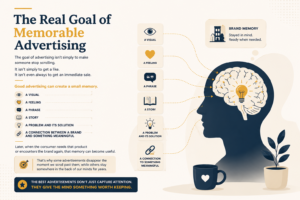
The goal of advertising isn’t simply to make someone stop scrolling.
It isn’t simply to get a like.
It isn’t even always to get an immediate sale.
Good advertising can create a small memory.
A visual.
A feeling.
A phrase.
A story.
A problem and its solution.
A connection between a brand and something meaningful.
Later, when the consumer needs that product or encounters the brand again, that memory can become useful.
That’s why some advertisements disappear the moment we scroll past them, while others stay somewhere in the back of our minds for years.
**The best advertisements don’t just capture attention. They give the mind something worth keeping.**
Final Thought
As digital marketers, we have access to more targeting, analytics and advertising technology than ever before.
But behind every impression is still a human being deciding what deserves their attention.
Understanding that human side of advertising can make our campaigns better.
The next time you create an advertisement, don’t ask only:
“Will people see this?”
Ask the more important question:
“What will they remember after they stop seeing it?”
Ready to Create More Memorable Advertising?
Understanding how people respond to advertising is only the beginning. The real challenge is turning that understanding into creative campaigns that capture attention, communicate clearly and build stronger brand recall.
**Want to make your advertising more memorable? Get in touch and let’s create campaigns that people don’t just see, but remember.**
Author: Basil VA